
Amid a fragile ceasefire, we at Sa7ten stood with our people to bring warmth, Sumud, and cultural pride back to Gaza’s communities.
Oct. 28, 2025
“People were tired of rice and canned food; we wanted to make something that would truly make them happy.”
– Abu Salah, our field coordinator
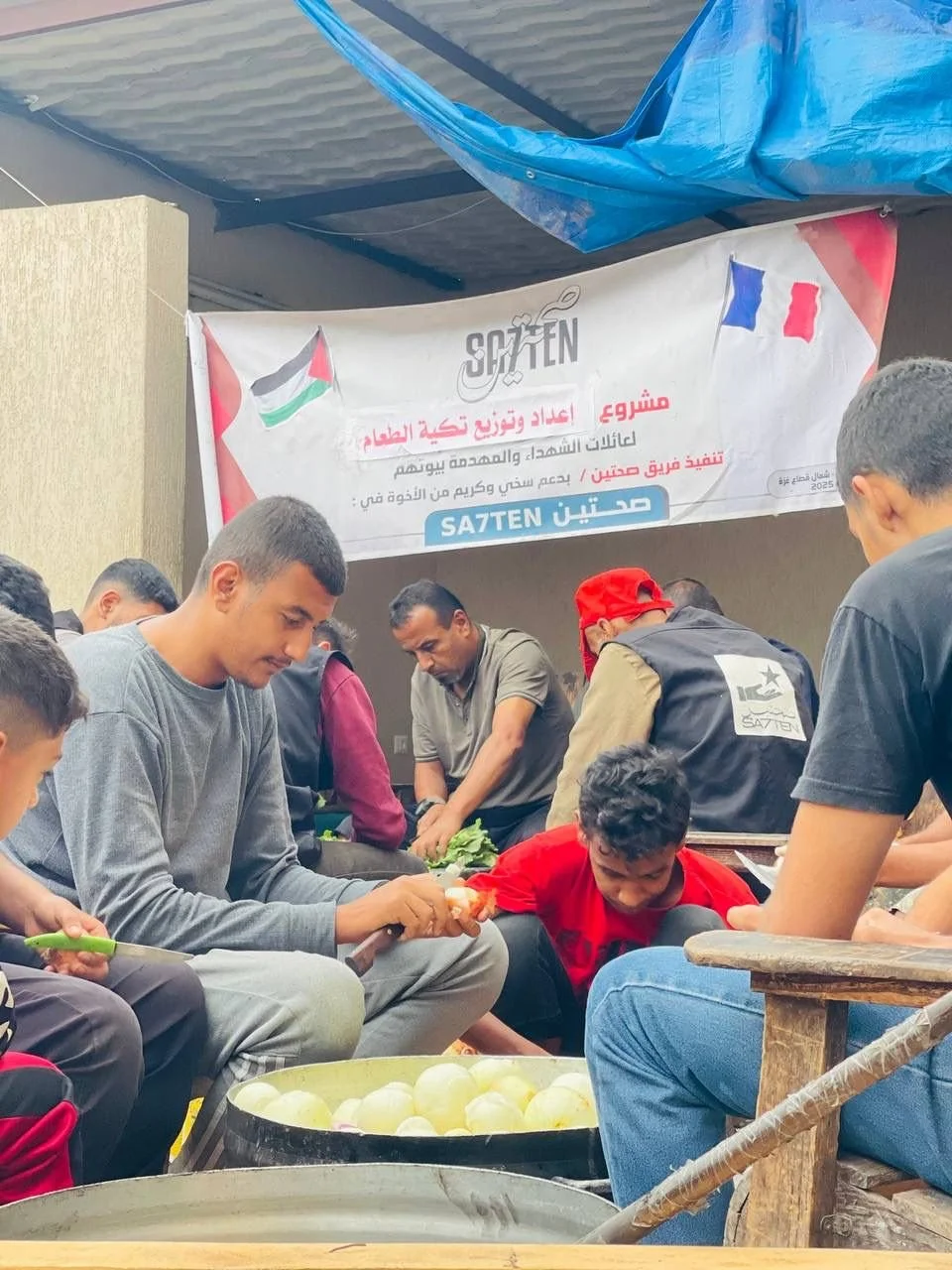
In Gaza, food often carries more meaning than sustenance. It becomes a story of belonging, defiance, and survival. That was the spirit behind our most recent activity – a massive communal preparation of Sumaqiyeh, one of Gaza’s oldest and most beloved dishes. Made from summac, chard, onions, and tahini, slow-cooked into a rich, tangy stew, Sumaqiyeh is a dish that belongs to celebration – a dish of Eid, of weddings, of good days. To make it now, in the ruins of a fragile ceasefire, was not simply an act of cooking – it was an act of resistance.
The ceasefire may have paused the airstrikes, but its fragility is felt in every conversation. The IOF continued to bomb sporadically across the Gaza Strip, violating the agreed-upon ceasefire terms. “At any moment, the agreement could fall apart because it’s very weak,” Abu Salah said. “The Zionist state never kept its covenant with the Palestinian people or with the international community.” Average pace of aid trucks entering since 10 October (through 27 October): ~89 trucks per day. The ceasefire framework discussed opening crossings to reach roughly 600 trucks per day, but Israel later told the UN it would allow a much smaller number and kept key crossings constrained or shut on multiple days. Al Jazeera has covered these shortfalls and closures throughout October. Yet even under that shadow, our people continue to rebuild, however modestly, however precariously. Streets remain broken, homes burned, and families scattered – but life goes on, through gestures of care and persistence.
For us at Sa7ten, the choice of Sumaqiyeh was deliberate. “Our people needed something that tastes like home,” said Ahmad, our operations manager. “They’ve eaten lentils, rice, and canned food for months. Sumaqiyeh is Gaza itself – it reminds people of weddings, holidays, family tables. It reminds them that joy is still possible.”
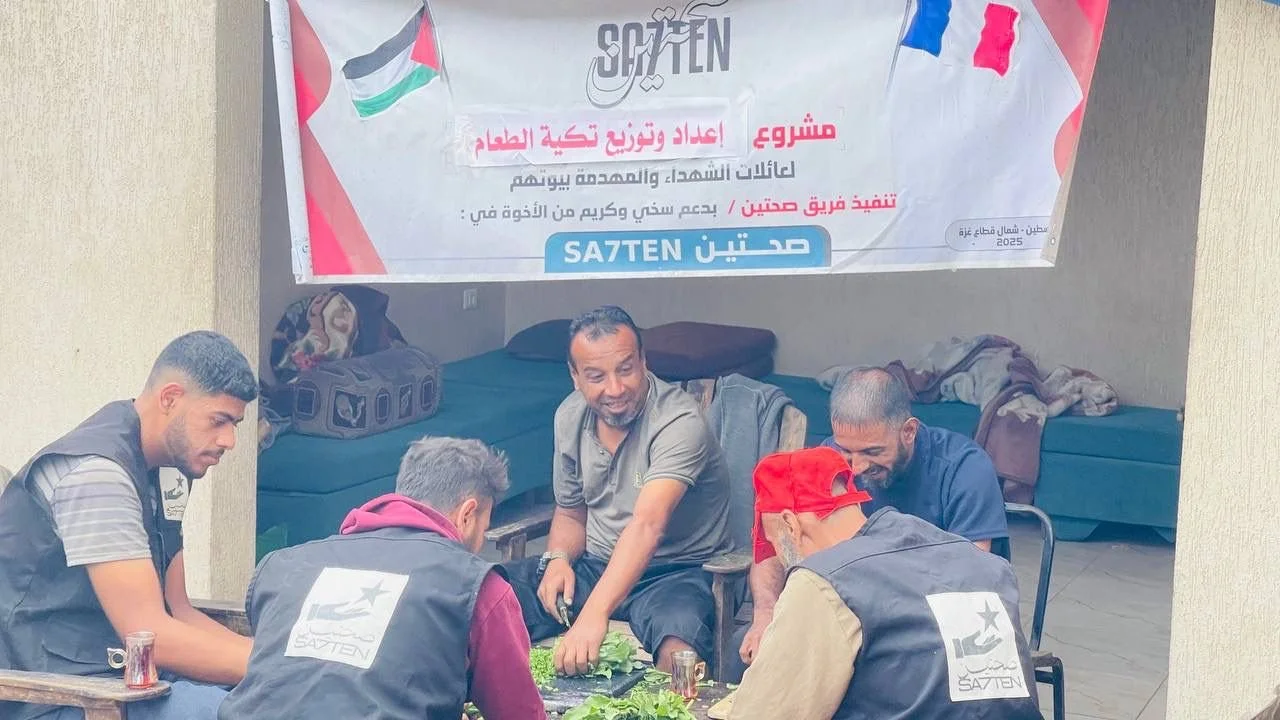
On the day of the event, our team and dozens of volunteers gathered in northern Gaza. More than 4,000 plates of Sumaqiyeh were prepared and distributed to displaced families across three camps – Al-Sa‘ada, Al-Ghalayiniya, and Al-Masha‘la. “We had more than twenty people working, ten women upstairs cutting onions and chard, and fifteen men downstairs managing the firewood and transport,” Abu Salah explained. “Some stayed all night just to make sure every family got their share.”
Volunteers used donkey carts to move the heavy cooking pots. Community members opened their homes to help – women prepared ingredients while men stirred the enormous pots, feeding people who had not shared a proper meal in months. “People couldn’t believe we were cooking like this – with such ingredients, such effort,” Abu Salah recalled.
The day ended not just with meals, but with laughter, the kind that feels foreign yet familiar in wartime Gaza. For a few hours, there was the scent of cooking instead of smoke, the sound of families eating together instead of the buzz of drones. It was a rare moment of normalcy – and strength.
The reality, however, remains severe. The ceasefire is fragile - if not nonexistent. Entire neighborhoods are still destroyed. Thousands of our people live in tents as winter approaches. Yet we continue – driven by the same principle that has defined our work from the beginning: to stand with our people and help them remain rooted in their land.
One of the key upcoming efforts is a blood donation drive, organized at the request of the National Blood Bank in Gaza. They reached out to us to help coordinate four separate blood donation activities, as supplies have fallen critically low. The blood is urgently needed for the many wounded in Gaza and those still receiving treatment amid the destruction. This is not the first time we have supported such initiatives – in previous months, under the heavy shelling of the criminal and genocidal IOF, we worked alongside medical teams to ensure blood donations could continue. We cover the costs of medical workers, prepare meals for donors, and provide stipends for volunteers who help organize each drive. These actions reflect our enduring role in supporting the healthcare system and sustaining the spirit of solidarity among our people.
We estimate the coming projects – including these blood donation drives and winter aid – will require nearly $20,000 (around 73,000 shekels) – a challenge under siege, but not impossible.
Now, more than ever, the responsibility falls on those outside Gaza. The people of Gaza do not ask for pity – they ask for solidarity. Our people have shown the world what resistance looks like. “Our people are more than capable of rebuilding their lives,” Ahmad said. “They’ve done it again and again. What they need are resources, not sympathy. We learn from them how to live freely and with dignity.”
Every act of support, every donation, every word, every connection, matters. It is not charity; it is participation in the rebuilding of a people who have never surrendered their humanity, even in the darkest times.
Our presence on the ground is a promise – to remain, to serve, and to stand. As Abu Salah put it: “Gaza will not break. This resistance will remain until full liberation is achieved.”
And as long as Gaza stands, we at Sa7ten will continue to stand with our people – until the city is rebuilt, until our people are free in their own land, no matter how long it takes.
