
“We will remain, even if we distribute food under showers of bullets, tank shells, and airstrikes. We will be among the last to remain in the north of Gaza, standing with the people who refuse to leave,”
- Ahmad, Sa7ten’s field operations manager.
In Gaza today, famine is no longer a looming threat but an enforced reality. This is the outcome of an ongoing genocide perpetrated by the Zionist state of Israel. Our people are being starved by design, held under a siege that blocks food, medicine, and fuel. Civilians are hunted in their homes and in the shelters they fled to, with buildings torn apart by bombs. This is not an accident of war but the open policy of a genocidal state determined to erase Palestinians from their land.
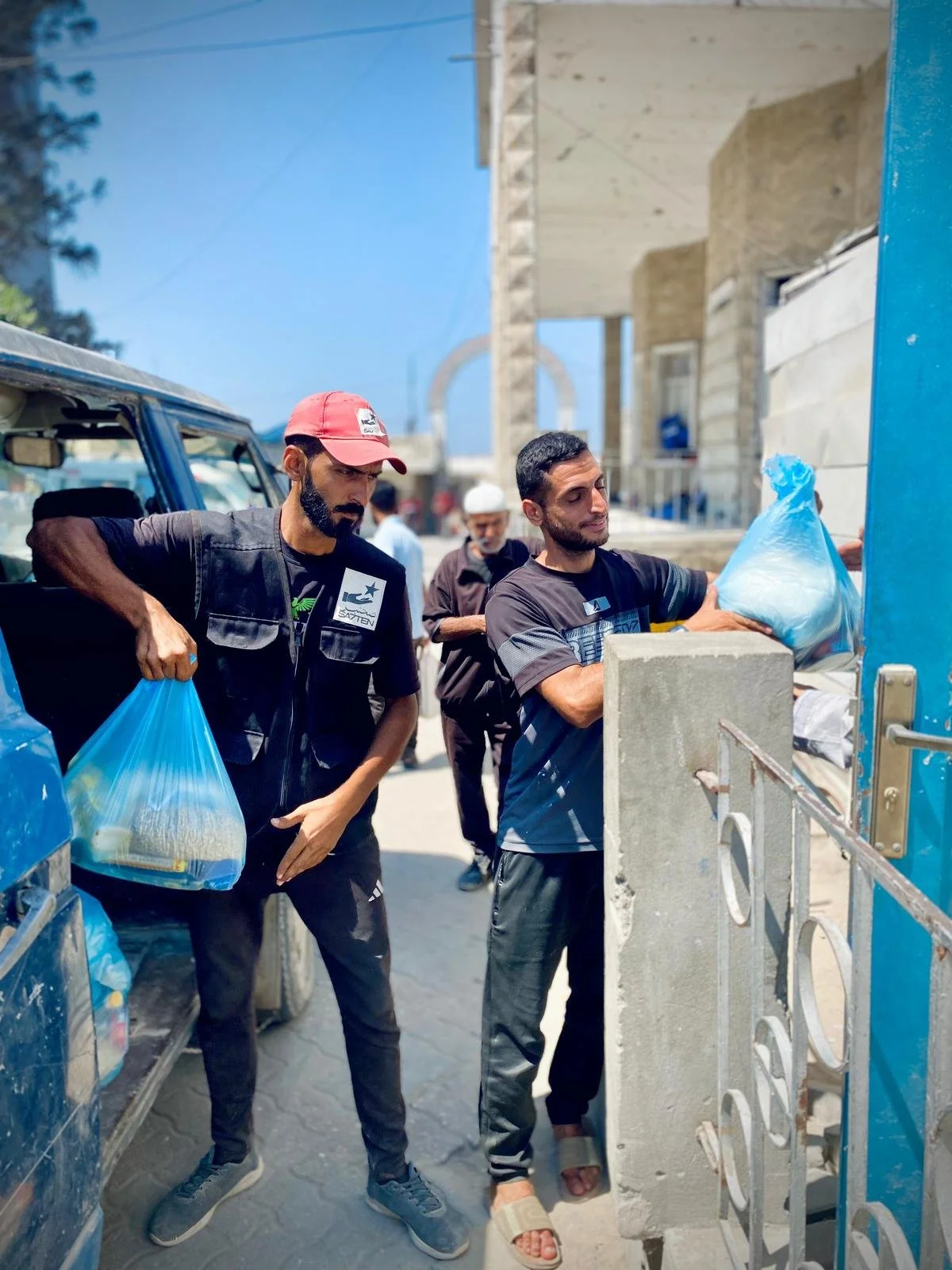
The Sa7ten team distributing food parcels at Al Shifa Hospital in Gaza.
Between September 1 and 7, as bombing pressed closer to Gaza City, Sa7ten’s team continued the work of survival. We prepared parcels, coordinated with hospitals, and placed food into the hands of families at a time when markets were empty and movement itself was life-threatening. In the first two days of September, our team worked from dawn to nightfall sourcing staples in collapsing markets, where sugar swung from ₪350/kg weeks earlier down to ₪22–23/kg, and yeast, once impossible at ₪400 a pack, was briefly secured at ₪40 - 41. Traders refused old bills, forcing us to take worse exchange rates just to get usable currency. Despite exhaustion and shelling, the team assembled parcels near al-Kateeba square and distributed them in western Gaza City, Tal al-Hawa, Yarmouk camp, al-Shati camp, and neighborhoods near al-Azhar and the Islamic University.
Ahmad, Sa7ten’s field operations manager, explained: “These parcels were made specifically for kidney patients and some of the injured.” The team prepared 50 family parcels, with 10–12 more delivered quietly off-camera. Each parcel carried nine essentials, including staples like flour, rice, sugar, pasta, oil, tahini, and canned goods, the best that could be sourced in such conditions. Dates were planned but could not be sourced, except through rare and costly airdrops. Initial coordination began at Al-Shifa Hospital; due to logistical difficulties, the main distribution was shifted to Al-Ahli (Al-Ma’madani). Beyond these hospital-focused parcels, earlier in the week hundreds more families displaced from al-Saftawi, al-Zaytoun, and al-Sabra received food in the west of Gaza City. Widows sent children or brothers to collect on their behalf; as one volunteer put it: “These parcels are carrying more than food; they are carrying the weight of families trying to stand another day.”
The distributions unfolded under fire. Ahmad recalls: “There was shelling about 200 meters from where we were. We carried out the activity as best as we could, as fast as we could, with whoever was present.” Beyond the bombing, the lack of goods in the market made each decision harder. Yet the work went on, because people needed food and because abandoning them was never an option. As one coordinator said: “Every day we see new faces, even if we distribute in the same place. The displacement never stops.”
Ahmad also speaks openly about the pressure on the team: “It is hard to think clearly, to make decisions the way we used to. Every choice now feels heavy.” Remaining in the north means exposure to siege and possible death. Leaving requires tents, transport, and safety that most cannot secure. Some members of the team prepared to move south, while others chose to stay. Ahmad promised to stand with each of them: “For those who stay, we will share even the smallest piece of bread. For those who leave, we will help them leave with dignity.”
Leaving the north is not a simple decision. For many families, it means starting again with nothing. A tent that once cost little now sells for 4,000–6,000 shekels (about $1,050–1,600), if one can even be found. A tarp is 400–550 shekels (about $110–150). Transporting a family by truck to the middle areas costs up to 1,500 shekels (about $400). Even ground to pitch a tent on is rented at 300–400 shekels a month (about $80–100). These are impossible sums for families bombed out of their homes again and again. Each displacement strips them of what little they managed to carry from the last. It is no surprise that so many insist on remaining rooted in their homes and neighborhoods, even under fire. To leave again would mean not only exile but destitution.
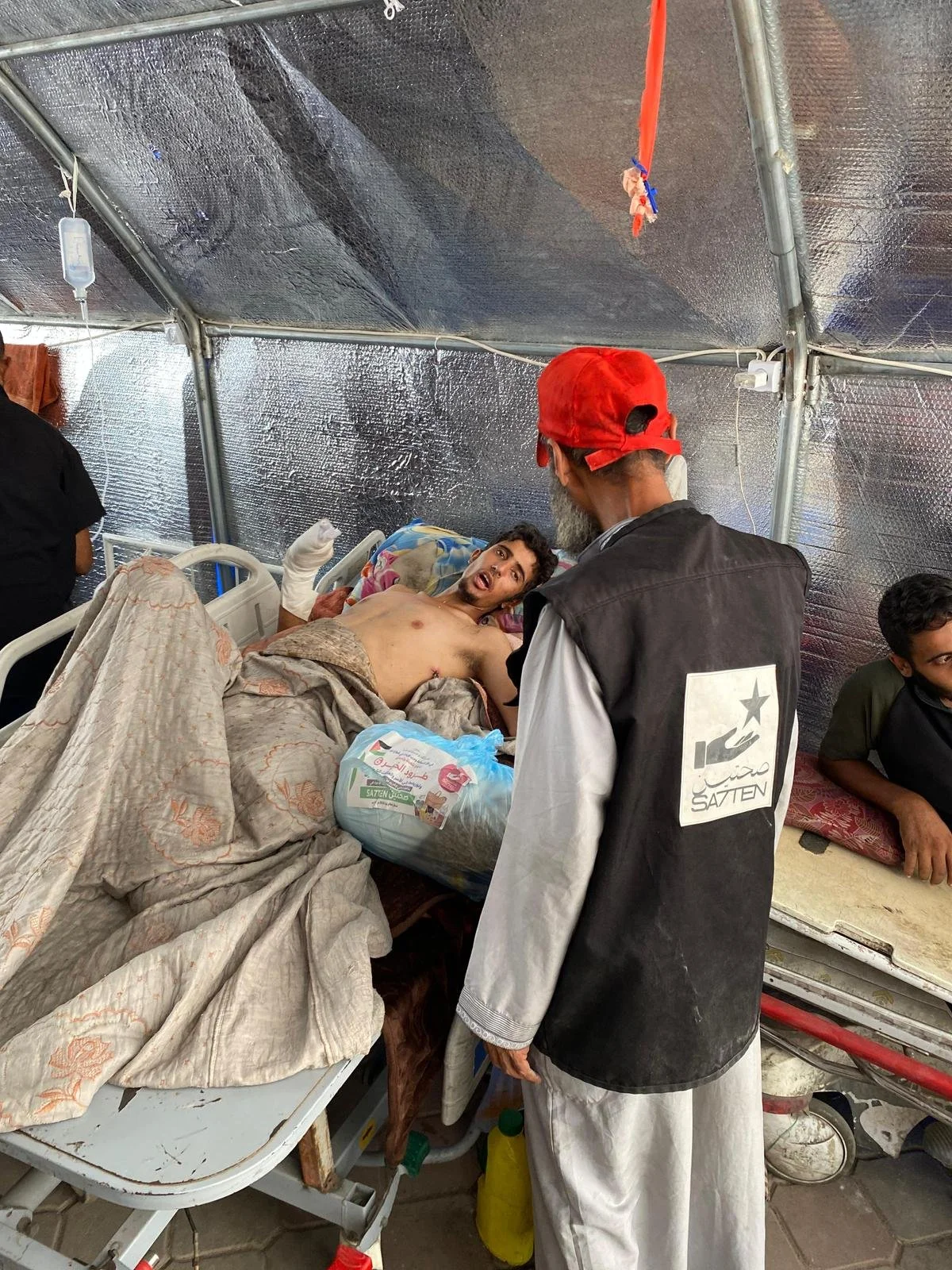
Sa7ten team visits injured Gazans at Al Shifa Hospital.
For Sa7ten, the task is clear: to help our people survive and to remain with them, whatever comes. As Ahmad put it, “Even when we have nothing left, we will still find a way to stand by the people here.” This means answering daily emergencies. A mother who cannot feed her baby receives infant formula and diapers, sometimes costing 500 to 600 shekels (about $130–160). When a child is wounded, medicine is bought immediately. Ahmad recalls the case of a girl with third-degree burns who needed a special cream: “It cost 250 shekels [about $65] every week, and we made sure she had it.” These are not side projects. They are the daily work of survival in the middle of genocide. As another team member said: “The humanitarian situation is below zero. If there were a word worse than nothing, that is what I would use.”
Even for those who decide to stay, the choice is not simple, it carries heavy burdens. Amid the destruction, many in Gaza refuse to leave their homes and neighborhoods, even as the cost of staying rises by the day. The decision is not only practical but also moral. Families know that each forced displacement robs them of what little they still have. Remaining, however, is also a declaration: that they belong to this land, and that no siege or bombardment can erase them. Sa7ten shares that choice, standing beside our people to the very end, whatever that end may bring.
In the coming days, Sa7ten will continue preparing food parcels and securing supplies. We will stand with those who cannot move. Our role is simple: to help people survive, and to remain by their side whatever comes. But survival in Gaza today demands more than presence. It demands action. International NGOs and humanitarian actors must move resources directly to where they are needed. Regional powers must end their complicity in the blockade and open humanitarian corridors without condition. And people outside Gaza must act: disrupt the governments that arm and fund this war. Join Palestinian-led movements. Boycott complicit corporations. Flood political offices with demands. Donate to Palestinian initiatives like Sa7ten. The time to resist and to act is now.
